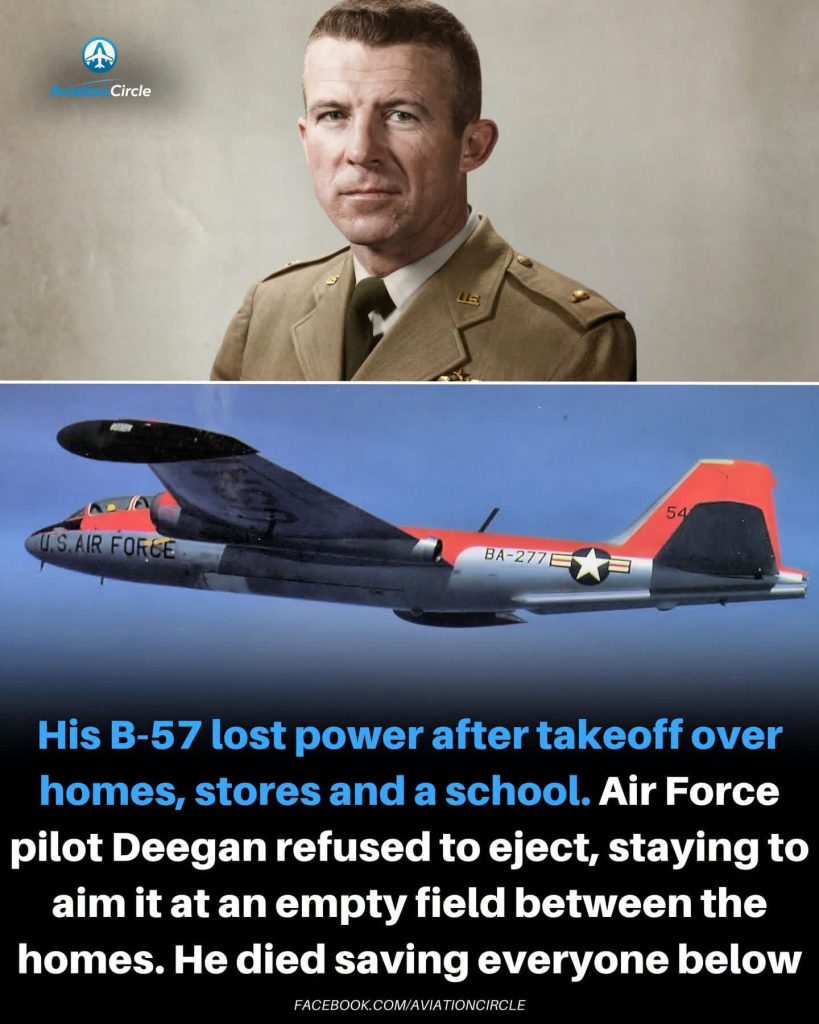
On a Sunday morning in September 1962, Air Force Maj. Thomas Deegan had just taken off from Tinker Air Force Base in Oklahoma when something went wrong.
Deegan was 37, from Attleboro, Massachusetts, with 18 years in the Air Force. He had a wife and 8 children.
Behind him sat Airman 1st Class Bobbie Rolland, 25, from Rossville, Georgia. He had a wife and 2 children.
Deegan radioed the tower that he was “having difficulty with the engines.” The jet was coming down over Midwest City. Under it were houses, a shopping center and a school.
Midwest City had been through this before. Just over a year earlier, another jet that had refueled at Tinker crashed into a neighborhood there. 2 little sisters, ages 2 and 4, were lost.
Deegan could have ejected and saved himself. But then nobody would be steering the jet.
So he stayed.
Dr. Thomas Dunn was working in his backyard. He heard the jet, and it “didn’t sound right.” Then he watched it bank sharply away from a housing development and dive.
Deegan steered it into a 500-yard field between occupied houses. The whole flight lasted about 2 minutes.
Rolland ejected about 75 feet above the ground. His parachute didn’t fully open. A security guard reached him first, but he passed away shortly after.
Deegan never ejected. Not one person on the ground was lost.
He couldn’t save the jet. So he saved everyone under it.
The Air Force’s own history puts it plainly: “Instead of saving his own life by ejecting from the crippled aircraft, the pilot had gone down with the plane.” One investigator said he did “a fantastic job steering.”
Then came the part almost nobody talks about.
His wife lost her husband. His 8 children lost their father. His daughter Maureen was only 8 years old. Decades later, she said, “one never gets over the loss.”
A father of 8 had a way out, and he gave it up for a neighborhood full of strangers.
His name was Thomas Deegan. Remember it.