
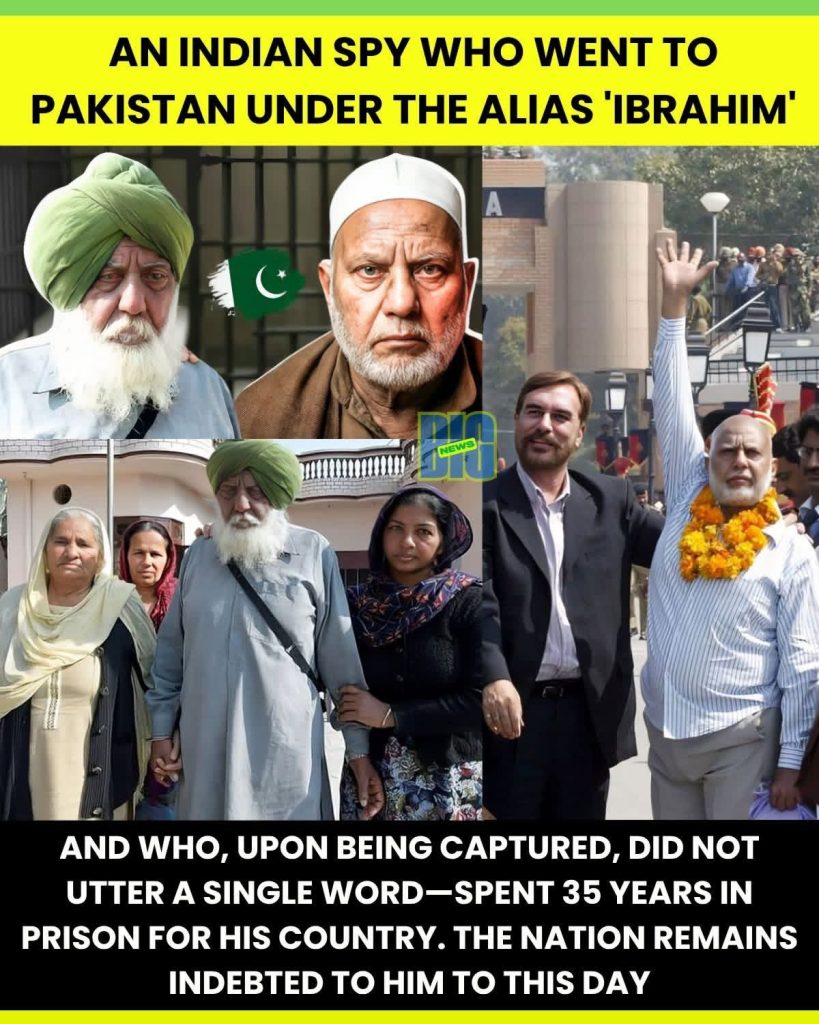
This is the story of Indian spy Kashmir Singh, who was unfortunately captured in Pakistan about 53 years ago. As fate would have it, he spent 35 years in Pakistani prisons following his capture in 1973. The tale of his bravery is currently going viral on social media.
When Kashmir Singh returned to India in March 2008, after spending 35 years in Pakistani jails, it was not merely a return home; it was as if he were emerging from a ‘time capsule’ sealed in 1973—a man whose youth had slipped away behind prison bars and chains. Shesh Paul Vaid, former Director General of Police (DGP) of Jammu and Kashmir, has paid tribute to him.
Kashmir Singh was born in Punjab in 1941. By the early 1960s, he had joined the Indian Army, serving from 1962 to 1966—a period when the morale of the Indian Army had been severely shaken following the war with China. After leaving the Army, he joined the Punjab Police—a profession that offered stability, if not fame.
Later, Kashmir Singh was approached to work on a contract basis for an Indian intelligence agency. It is reported that he agreed to undertake this high-risk assignment for a monthly remuneration of approximately 400 rupees. A social media user shared his story, and the former J&K DGP has lauded his courage.
In the early 1970s, intelligence work was exceptionally arduous and demanding. There were no digital footprints, nor was there the luxury of accessing satellite imagery with a single click. Information had to be gathered firsthand, a task that often entailed immense personal risk. Kashmir Singh entered Pakistan under the name ‘Mohammad Ibrahim’
According to media reports, Kashmir Singh entered Pakistan in 1973 using the name ‘Mohammad Ibrahim’. At the time, this was not an unusual tactic; adopting a disguise was essential for survival. It is reported that Kashmir Singh even obtained identification documents under this alias and used it to check into hotels.
Kashmir Singh was captured on the Peshawar-Rawalpindi road:
According to reports, Kashmir Singh was arrested by Pakistani intelligence officials near the Peshawar-Rawalpindi road. He faced charges ranging from espionage to smuggling—accusations that would go on to define the rest of his life. Back in India, his wife, Paramjit Kaur, was left alone to care for their three young children, all of whom were under the age of ten.
A Pakistani military court sentenced Kashmir Singh to death
In late 1973, a Pakistani military court sentenced Kashmir Singh to death. In the mid-1970s, civilian courts upheld this verdict, effectively sealing his fate. A mercy petition was subsequently filed, but it brought no relief. Instead of being executed, his sentence was commuted to something perhaps even more cruel: a long, uncertain life as a prisoner on death row.
Kashmir Singh recounts that he was subjected to severe torture during his initial months in prison, as officials sought to force a confession. Over the next three and a half decades, he was held in seven different Pakistani jails. He spent 17 years in chains and endured long periods in solitary confinement. There were even years when he neither saw the sky nor had any human contact. When the matter reached Musharraf, everything changed:
It was 2008 when Ansar Burney, a Pakistani human rights activist serving as the Minister for Human Rights, visited a prison in Lahore. There, he encountered an elderly Indian prisoner who had been incarcerated for 35 years. Burney later noted that, due to such a long period of imprisonment, the man—Kashmir Singh—had completely broken down mentally.
Shocked by the duration of Kashmir Singh’s confinement and the conditions he endured, Burney raised the issue on humanitarian grounds. He argued that no individual—regardless of any political charges they might face—should be left to languish in prison for decades without a verdict. His appeal reached the highest levels of the Pakistani government.
When Pervez Musharraf, the then-President of Pakistan and a former military general, was informed about the case, he found it hard to believe. Shortly thereafter, Kashmir Singh was granted a presidential pardon, which included provisions for his release and repatriation to India.
The long journey home:
On March 4, 2008, Kashmir Singh returned to India via the Wagah border. The scene was truly unforgettable: a frail man, appearing far older than his actual years, stepped into a country that had transformed so much it was barely recognizable to him. He was welcomed by officials, the media, and his family. His relatives, who had waited for him for over three decades, were overcome with emotion.
His reunion with his wife, Paramjit Kaur, was deeply poignant. She had spent the better part of her life in a state of limbo—neither a widow nor a wife in the conventional sense—clinging to the hope that her husband would one day return. Back in his village, Kashmir Singh was welcomed like a hero.