
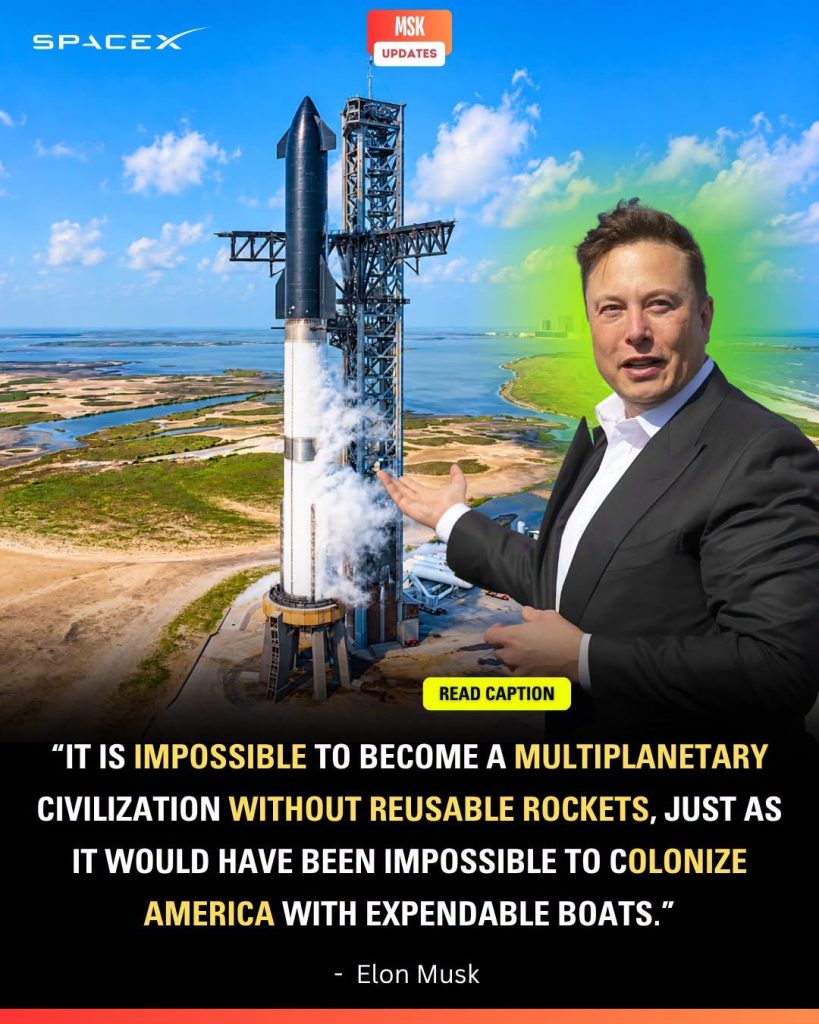
⚡️ Elon Musk believes that humanity’s future in space depends on one major breakthrough: making rockets reusable.
In a post shared on May 4, 2026, Musk explained why he considers reusable rockets essential to becoming a multiplanetary civilization.
He compared the challenge to the history of ocean exploration, arguing that it would have been impossible to colonize distant lands if ships had to be discarded after every journey.
His message reflects the central goal behind SpaceX’s long-term development program: creating rockets that can launch, return to Earth, and fly again instead of being treated as disposable machines.
Traditional rockets have historically been expensive because many of their major components were lost after launch. Recovering and reusing hardware can help spread manufacturing costs across multiple flights, reduce the need to build new vehicles for every mission, and potentially increase launch frequency.
SpaceX has already demonstrated this approach with its Falcon 9 program, regularly landing and reusing first-stage boosters. Starship takes the ambition much further.
The company is developing a fully reusable launch system made up of the Super Heavy booster and the Starship upper stage, with the goal of recovering and flying both parts again.
The bigger ambition is not simply to send a spacecraft to Mars once. Musk wants a transportation system capable of carrying people, equipment and supplies repeatedly between Earth and other worlds. Achieving that would require major improvements in launch reliability, recovery operations, refueling, manufacturing and cost.
That vision remains a long-term engineering challenge. Making rockets reusable at scale, supporting frequent launches and establishing a sustainable human presence beyond Earth are goals that still require substantial development and testing.
But the principle behind Musk’s message is clear: if humanity wants to explore other planets on a much larger scale, space travel must become more affordable, repeatable and accessible.
The future of space exploration may depend not only on how far rockets can travel, but also on how many times they can make the journey.