QUEBEC’S RELIGIOUS-SYMBOL RESTRICTIONS SPARK FRESH CONTROVERSY IN MONTREAL AS SCHOOL WORKERS FACE DIFFICULT CHOICES.
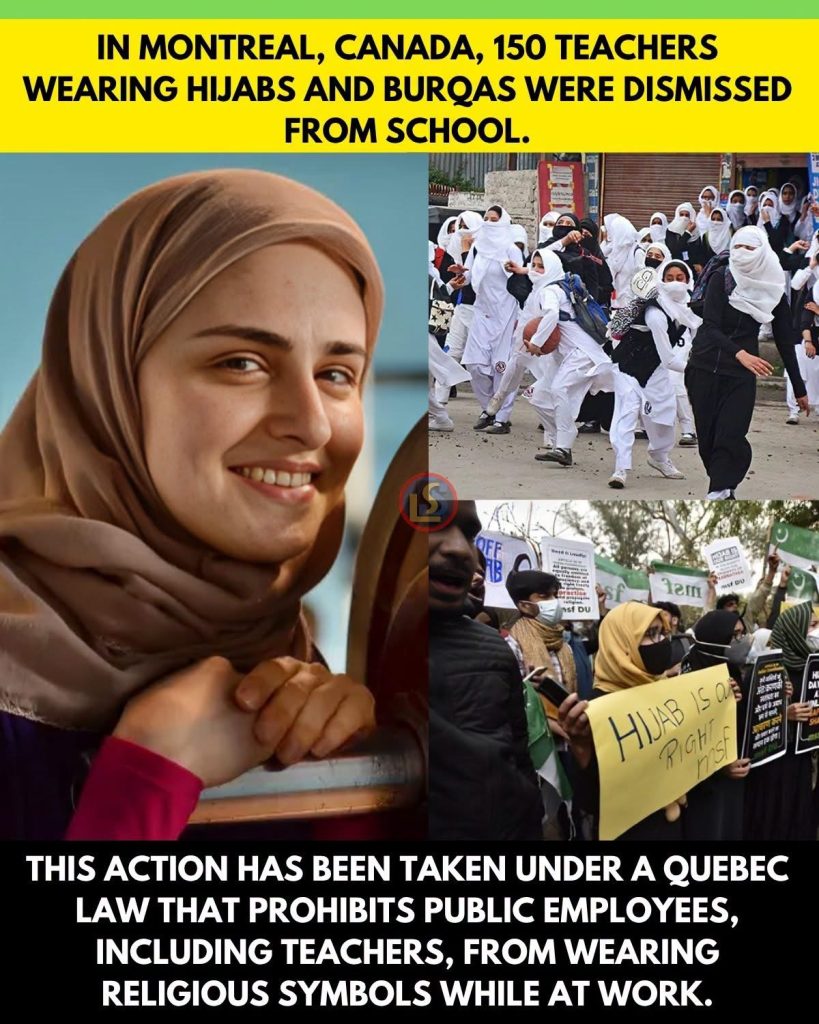
A controversy surrounding Quebec’s secularism laws has once again attracted widespread attention after reports suggested that approximately 150 employees associated with Montreal’s largest school service centre had left their positions amid disputes over restrictions on visible religious symbols. The situation has renewed discussions about religious freedom, workplace rights, equality, and the role of secularism in public education.
However, an important distinction must be made regarding claims circulating on social media. Some viral posts suggest that 150 teachers wearing hijabs or burqas were dismissed, but the available accounts described in these reports indicate a more complicated situation. The affected individuals reportedly included support workers and other school employees, rather than teachers alone. There is also insufficient evidence to conclude that every affected employee wore a hijab or burqa.
Quebec’s Bill 21, adopted in 2019, introduced restrictions on visible religious symbols for certain public-sector employees exercising positions of authority, including public-school teachers. The legislation applies to religious symbols associated with different faiths rather than explicitly targeting one religious community.
The debate has intensified as Quebec has pursued additional secularism requirements within educational institutions, extending certain restrictions to more categories of school personnel. These developments have raised questions about how public institutions should balance religious neutrality with the individual freedoms of employees.
Supporters of the legislation argue that public institutions should maintain religious neutrality and that government employees in designated roles should follow common standards. They believe such rules reinforce Quebec’s secular model and help ensure that public services operate independently of religious influence.
Critics, however, maintain that restrictions on visible religious symbols can have unequal practical consequences, particularly for people whose religious practices involve wearing identifiable clothing or accessories. Muslim women who wear the hijab are frequently mentioned in this debate because such restrictions may affect their ability to pursue or continue certain careers in public education.
Opponents also argue that employees should not have to choose between professional opportunities and sincerely held religious beliefs. They warn that such requirements may create barriers to employment, reduce workplace diversity, and raise concerns about freedom of religion and equal treatment.
The controversy reflects a broader question faced by democratic societies: **How should governments maintain secular public institutions while protecting the religious freedom and employment rights of individuals?
Secularism, equality, religious liberty, workplace protections, and social integration are all important considerations. Finding an appropriate balance requires careful examination of the law, its practical effects, and the experiences of people directly affected by it.
The Montreal situation also demonstrates why accurate reporting matters. Viral headlines can oversimplify complicated legal and employment disputes, making it essential to distinguish confirmed developments from incomplete or exaggerated claims.
Ultimately, meaningful discussion about Quebec’s religious-symbol rules should be grounded in accurate information, respect for individual dignity, and a clear understanding of the competing principles of secular governance and religious freedom.